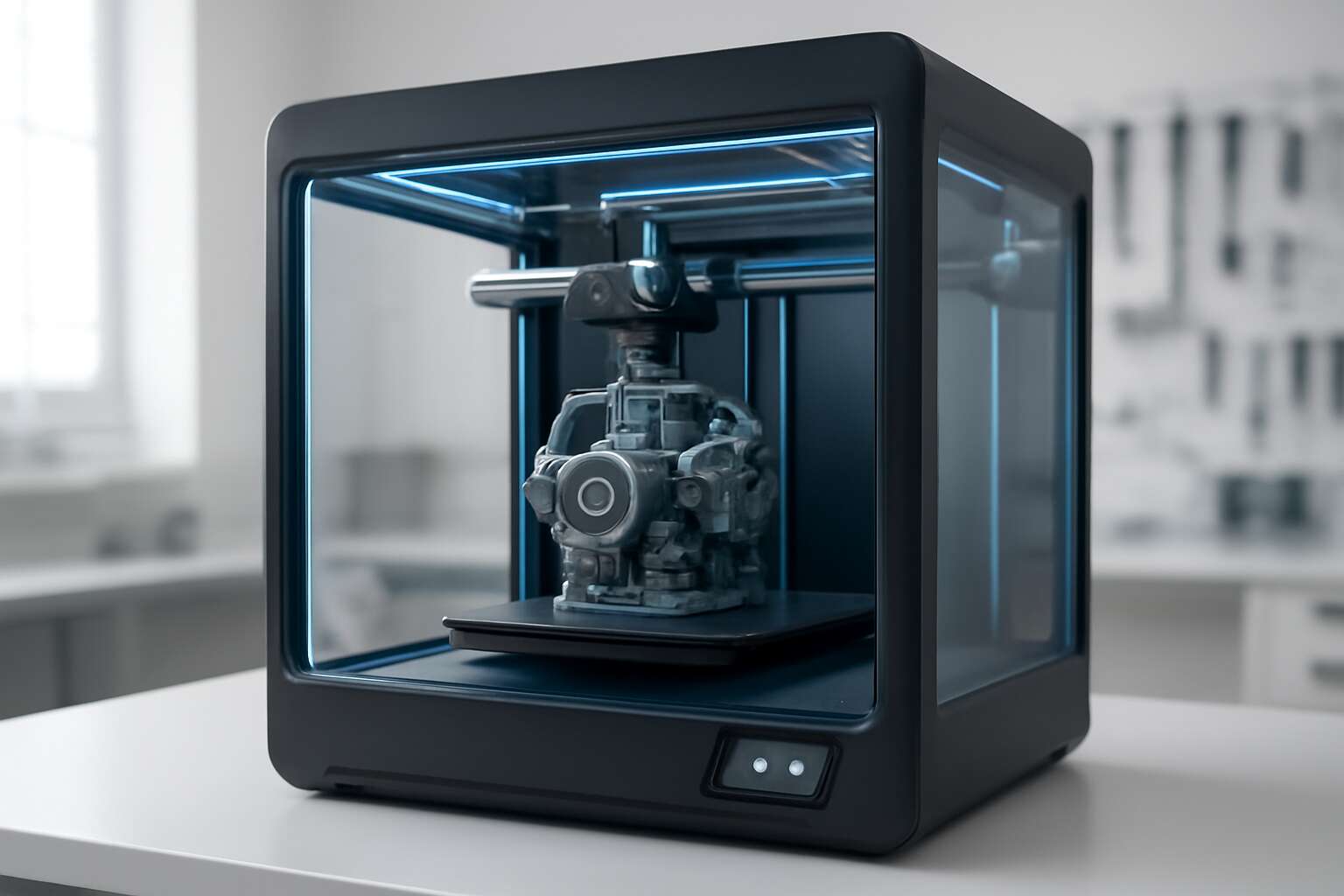
Premium features that define top-tier 3D printers
Precision and print quality – Explain how resolution, layer height, surface finish, and dimensional accuracy drive overall product quality.
In the studio of the future, every layer hums with intention and precision speaks in microns. Industry chatter suggests that printers with stable temperatures and exacting control cut post-processing time by up to 60%—a bold promise that turns concept into finished reality.
A high quality 3d printing machine translates design intent into tangible parts. Resolution, layer height, and dimensional accuracy are the triad that determines product fidelity. Finer layer heights yield smoother surfaces and tighter tolerances, while raster uniformity guards against stair-stepping and warping.
- Closed-loop extrusion with real-time feedback for consistent material flow
- Heated bed and thermal enclosure for dimensional stability across materials
- High-precision nozzles and calibrated axes for repeatable accuracy
Each characteristic coalesces into dependable repeatability, a trait we champion in industries from prototyping to tooling here in South Africa—and beyond.
Reliability and uptime – Discuss build quality, component durability, routine maintenance, and long-term performance.
In the studio of the future, uptime is a metric that matters. Some South African factories report up to 98% uptime when backed by a high quality 3d printing machine. Reliability translates to fewer bottlenecks and faster iterations, turning concept into repeatable parts.
Build quality and component durability underpin every reliable print. A machine built for stable temperatures, solid frames, and rugged drives resists the wear that drags production down! Routine maintenance becomes a preventive discipline, safeguarding long-term performance.
- Rigid chassis and hardened drives
- Thermal stability across materials
- Accessible calibration checks
With these elements, reliability becomes a tangible asset for South Africa’s prototyping and tooling ecosystems, delivering consistent output and minimal downtime.
User experience and interface – Cover ease of use, software compatibility, hardware controls, and calibration workflows.
In South Africa’s studios that move at the speed of thought, the user experience is the hidden accelerator. A clean interface, sensible defaults, and tactile hardware cues turn setup time into downtime avoided. For teams chasing a high quality 3d printing machine, the UX is the cherry on the cake.
Key features that define top-tier user experience include:
- Intuitive touchscreen controls with context-aware prompts
- Software compatibility across popular CAD and slicer ecosystems
- Robust calibration workflows and accessible hardware adjustments
From cloud firmware updates to plug-and-play peripherals, premium UX layers keep teams focused on design, not debugging.
Safety and certifications – Highlight safety features, material handling, and industry compliance certifications.
South Africa’s studios deserve more than speed; they deserve safeguards that keep talent safe while ideas ignite. A high quality 3d printing machine stands on a wall of safety features: enclosed chambers with rugged interlocks, fume management, and automatic thermal runaway protection. Material handling is designed to minimize spills and exposure, with clearly labeled feeds, spill containment, and waste streams that are easy to dispose of. In daily use, these measures translate to calmer desks and steadier production.
- CE marking and RoHS compliance for global distribution
- UL/CSA listings or equivalent safety certifications
- ISO 9001 quality management and robust factory traceability
- SABS or equivalent regional certifications in Southern Africa
With safety close at hand, premium engineering harmonizes protection with performance, reinforcing the promise of a measured, predictable workflow. For South African studios, that guardianship is not a restraint but a competitive advantage.
Energy efficiency and footprint – Discuss power usage, quiet operation, and compact design considerations.
In South Africa’s bustling studios, energy-smart choices become quiet competitive differentiators. This is the promise of a high quality 3d printing machine that sips electricity rather than roars through it, trimming running costs while preserving throughput.
Energy usage, when thoughtfully engineered, dissolves into the background: whisper-quiet fans, precise thermal management, and standby modes that cut idle draw without sacrificing readiness. Footprint matters too: compact footprints fit snugly beside desks, freeing floor space for collaboration and creativity. The result is a printer that fits the studio, not the other way around.
Key leverage points include:
- Efficient motors and drivers
- Integrated cooling or heat recovery
- Low-power standby and intelligent power management
Performance benchmarks for demanding applications
Print speed versus quality balance – Describe speed modes, acceleration, and how to optimize for quality without sacrificing time.
Across demanding applications, speed and fidelity aren’t rivals but partners! In field tests, teams using a high quality 3d printing machine slashed iteration cycles by up to 38%, turning tight timelines into tangible parts and confident approvals.
Speed modes and smart acceleration let you tailor output on the fly. Standard mode balances pace and precision; Turbo ramps up acceleration for complex geometries; Quiet mode dampens motion to stabilize surfaces. Fine-tuning print parameters—pathing and cooling—lets you squeeze more performance from time already saved.
- Standard: balanced throughput
- Turbo: fastest acceptable speed
- Quiet: smoothest operation
In South Africa, consistent throughput matters for local manufacturers, service bureaus, and education centers. This system translates into dependable uptime and predictable delivery windows for every job, every day.
Dimensional accuracy and repeatability – Explain calibration routines, tolerances, and quality-control checks.
Across demanding applications, performance hinges on trust as much as speed. Field trials with a high quality 3d printing machine showed that disciplined calibration slashes dimensional drift and speeds up sign-offs, turning tight deadlines into tangible parts. In South Africa’s shops and classrooms, consistent accuracy translates to fewer reworks and brighter futures, where each iteration nears a perfect fit!
Dimensional accuracy and repeatability are governed by well-maintained calibration routines, sensible tolerances, and robust quality-control checks. Teams calibrate not just a single print, but the relationship between heat, resin or filament, and motion, tracking variance across runs and across geometries. The result is dependable parts replete with uniform surfaces and predictable performance at scale.
Material versatility and extrusion compatibility – List supported materials, nozzle options, and drive mechanisms.
Layer adhesion and post-processing impact – Analyze bed adhesion, first-layer performance, and finishing requirements.
Performance benchmarks for demanding applications hinge on bed adhesion and first-layer stability. A high quality 3d printing machine keeps bed temperature and Z-offset tight, so the base layer sits down cleanly. When adhesion falters, finishing requirements balloon with warps and surface irregularities.
- Bed adhesion strategies and surface engagement: surface types and temperature compatibility
- First-layer fidelity: nozzle calibration and extrusion consistency
- Post-processing footprint: how layer quality influences finishing time and effort
Finish quality hinges on predictable layer sets. The right combination of bed stability and material flow reduces variation in surface texture and minimizes sanding or coating needs later. Across demanding geometries, repeatable bed leveling and controlled environment translate into reliable outcomes with minimal rework.
Consistency across builds – Outline batch testing, monitoring, and QC workflows.
Quality is not an act, it is a habit. When performance benchmarks matter, consistency across builds and reliable uptime are the difference between a prototype and a ready-for-market part. A high quality 3d printing machine keeps batch runs predictable, minimizes drift between prints, and trims rework on the table.
Consistency across builds rests on three pillars:
- Batch testing cadence across materials, geometries, and print profiles.
- Real-time monitoring dashboards that track temperature, extrusion, and axis stability.
- Standardized QC checks for dimensional tolerances, surface finish, and feature fidelity.
With these guardrails, a production line becomes less tense and more scalable. The result is uniform parts and shorter iteration loops, even under South African manufacturing pressures, all enabled by a properly calibrated system.
Materials and compatibility for high-end 3D printing
Filament and resin compatibility – Describe supported materials, resin types, and feed systems.
In SA studios, a high quality 3d printing machine trims development cycles by up to 40%, turning bold ideas into prototypes overnight and letting teams iterate with confidence!
The device handles a spectrum of filaments and resins to cover mechanical, cosmetic, and functional parts. Supported materials include:
- Filaments: PLA, PETG, ABS, Nylon, PC, and flexible TPE
- Resins: standard UV-curable, tough, flexible, and ceramic-filled
Feed systems combine open-material spools with auto-loading, smart tension sensors, and a dual-extruder option; resin handling uses a controlled vat with agitation and a UV-safe hood.
Infill patterns and structural integrity – Discuss infill choices, lattice designs, and their impact on strength.
Materials and compatibility set the limits of what a high quality 3d printing machine can yield in final parts. When you choose filaments or resins, infill patterns determine how load travels through the object, shaping weight, stiffness, and durability.
Explore patterns that balance strength with efficiency. Common choices include:
- Gyroid lattice for uniform strength and excellent isotropy
- Honeycomb for crush resistance and good energy absorption
- Concentric or tuned lattice variants for calibrated flex and weight reduction
- Grid or triangular layouts when speed and straightforward printing matter
In South Africa’s engineering landscape, lattice geometry directly influences durability under real-world conditions. The right infill choice enhances dimensional stability and lifecycle performance, reinforcing why a high quality 3d printing machine is a strategic asset for precise, repeatable production.
Support structures and soluble supports – Explain support types, removal ease, and post-processing considerations.
In South Africa’s bustling engineering studios, materials and compatibility are the quiet engines behind every flawless part. A high quality 3d printing machine doesn’t merely print; it negotiates with filament and resin to shape strength, stiffness, and the tactile finish end users feel.
Support structures and soluble options unlock complexity. Breakaway supports pop off with minimal effort on broad surfaces, while soluble supports like PVA or BVOH dissolve away in water or gentle baths, leaving delicate overhangs pristine. The choice hinges on geometry, layer order, and post-processing tolerance.
For clarity, consider these options:
- Soluble supports (PVA, BVOH) for intricate cavities and internal channels
- Breakaway supports for faster cleanup and simple geometries
- Solvent-assisted removal strategies for resin parts with stubborn residue
Post-processing considerations extend beyond removal: plan for thorough washing, controlled curing where applicable, and careful surface finishing to preserve dimensional accuracy and part fidelity in high-stakes applications.
Print bed technology and adhesion options – Cover build surfaces, bed temperature control, and adhesion strategies.
Print perfection on South Africa’s workshop floors hinges on the bed as much as the nozzle. A recent industry snapshot shows up to 50% of part failures stem from bed adhesion issues. A high quality 3d printing machine becomes a quiet forge, where heat, texture, and first-layer fidelity choreograph the build.
Materials and compatibility guide how the bed speaks to filament or resin. Build surfaces must harmonize with the chosen material, offering stable yet forgiving adhesion. Common options include tempered glass, PEI sheets, and specialty coatings. Bed temperature control keeps warping at bay and tunes layer bond strength. Adhesion strategies—textured surfaces, spring-loaded clips, or gentle-release films—deliver reliable starts without marring delicate edges.
- Tempered glass, PEI, and coated build surfaces
- Stable bed temperatures tuned to material
- Adhesion options: textured films, tapes, edge clips
Post-processing readiness – Outline cleaning, curing, sanding, and finishing workflows.
In a South African workshop, the first touch often decides the day: a part emerges with clean edges, ready for the next stage. Materials and compatibility shape how post-processing starts—an essential advantage for a high quality 3d printing machine.
Choosing resins and filaments that harmonize with finishing regimes keeps surfaces predictable. The right material brings compatible curing windows, predictable sanding responses, and robust coating adhesion, reducing surprises after cure.
- Cleaning and surface preparation
- Curing or post-cure timing
- Sanding and surface refinishing
- Finishing and protective coatings
That alignment pays off in the long run, turning every project into a smoother journey from print to polish, especially when your equipment and materials speak the same language.
Cost of ownership and long-term savings
Initial investment and total cost of ownership – Compare upfront price against features, reliability, and lifecycle.
Across South Africa’s bustling workshops, price is only part of the story. A high quality 3d printing machine couples precision with dependable uptime, turning once-limiting bottlenecks into routine productivity. The upfront investment may be steeper, but the long-term payoff emerges in tighter tolerances and less waste.
Initial investment and total cost of ownership should be balanced against features, reliability, and lifecycle. Consider these factors:
- Upfront price aligned with feature set and build quality
- Reliability, uptime, and routine maintenance costs
- Lifecycle value, including service, spare parts, and potential resale
Over the product’s life, energy efficiency, quiet operation, and durable components reduce total spend, making this option a savvy choice for South African businesses seeking consistent output and growth.
Maintenance costs and spare parts availability – Discuss consumables, part lifetimes, and supplier support.
Reliability is the quiet engine of growth, as one veteran engineer writes. In South African workshops, the cost of ownership for a high quality 3d printing machine stretches beyond the sticker price, touching uptime, waste, and cadence. A robust machine minimizes unplanned stops, tightens tolerances, and lowers per-part costs over its lifetime. The upfront investment may be steeper, but the long-term payoff is steadier production and higher yield per shift.
Maintenance costs and spare parts availability demand careful consideration:
- Consumables and part lifetimes: filament, resin, nozzles, belts, bearings; replacement windows.
- Maintenance costs and spare parts availability: local SA suppliers, stock levels, and warranty terms.
- Supplier support and service: regional partners, remote diagnostics, and upgrade paths.
With the right network of supplier support and readily available spares, the total cost of ownership for a high quality 3d printing machine becomes a strategic edge for South African manufacturers—turning uptime into growth.
Energy consumption and efficiency over time – Evaluate power draw, heat management, and efficiency gains.
Energy costs rarely stand still in South African workshops; they punch above their weight in shaping profitability. A high quality 3d printing machine designed with power management in mind turns energy spent into value earned, smoothing production cadence and reducing per-part energy drift over a lifecycle. The payoff isn’t flashy—it’s steadier throughput and lower unit costs over time.
- Power draw profiles: idle versus active printing help avoid wasted energy during warm-up and idle phases.
- Heat management: efficient enclosures and cooling keep components within spec and extend life.
- Efficiency gains: optimized motion planning and low-friction drives reduce energy per part.
- Cycle-time consistency: predictable energy use supports steady yields across shifts.
Over the long horizon, energy efficiency translates into measurable margins, especially when paired with dependable SA supplier support and robust spare parts availability. The quiet cadence of these systems yields less energy waste, more parts per shift, and a cleaner bottom line.
Reliability and downtime costs – Consider MTBF metrics, service windows, and downtime impact.
Ownership costs for a high quality 3d printing machine aren’t measured in upfront price alone. Across South Africa’s workshops, a clear MTBF (mean time between failures) expectation and a predictable service window shave hidden expenses from your ledger. When downtime is measured in minutes or hours rather than days, steady throughput becomes the real currency—turning energy and materials into margin, not waste. Over a lifecycle, the savings compound, quietly increasing reliability and resale value!
- MTBF metrics aligned with production calendars and shift patterns
- Defined service windows that minimize unscheduled downtime
- Downtime impact quantified in production loss and throughput stability
Over time the math tips in favour of the operator: fewer surprise billings, more consistent output, and a cleaner bottom line. A seasoned solution with planned maintenance windows keeps every shift moving, and returns a steadier ROI that South African shops can bank on.
Resale value and lifecycle planning – Project depreciation, upgrade cycles, and total ROI.
Profit is the rhythm of uptime, not the sticker price. In South Africa, currency volatility weighs on procurement, so a well-chosen asset delivers long-term savings through durable components, predictable upgrade paths, and maintenance windows that keep production lean. A high quality 3d printing machine converts upfront spend into steady throughput, smoothing depreciation and reducing the drag of downtime on every shift.
Resale value rewards disciplined lifecycle planning. Documented service histories, modular upgrades, and scalable configurations preserve value as demand shifts. When you align depreciation, upgrade cycles, and total ROI, the asset becomes a growing asset rather than a sunk cost. Consider lifecycle levers:
- Depreciation trajectory that mirrors production budgets
- Regular upgrade cycles to sustain performance and compatibility
- ROI measured by throughput consistency and material efficiency


0 Comments