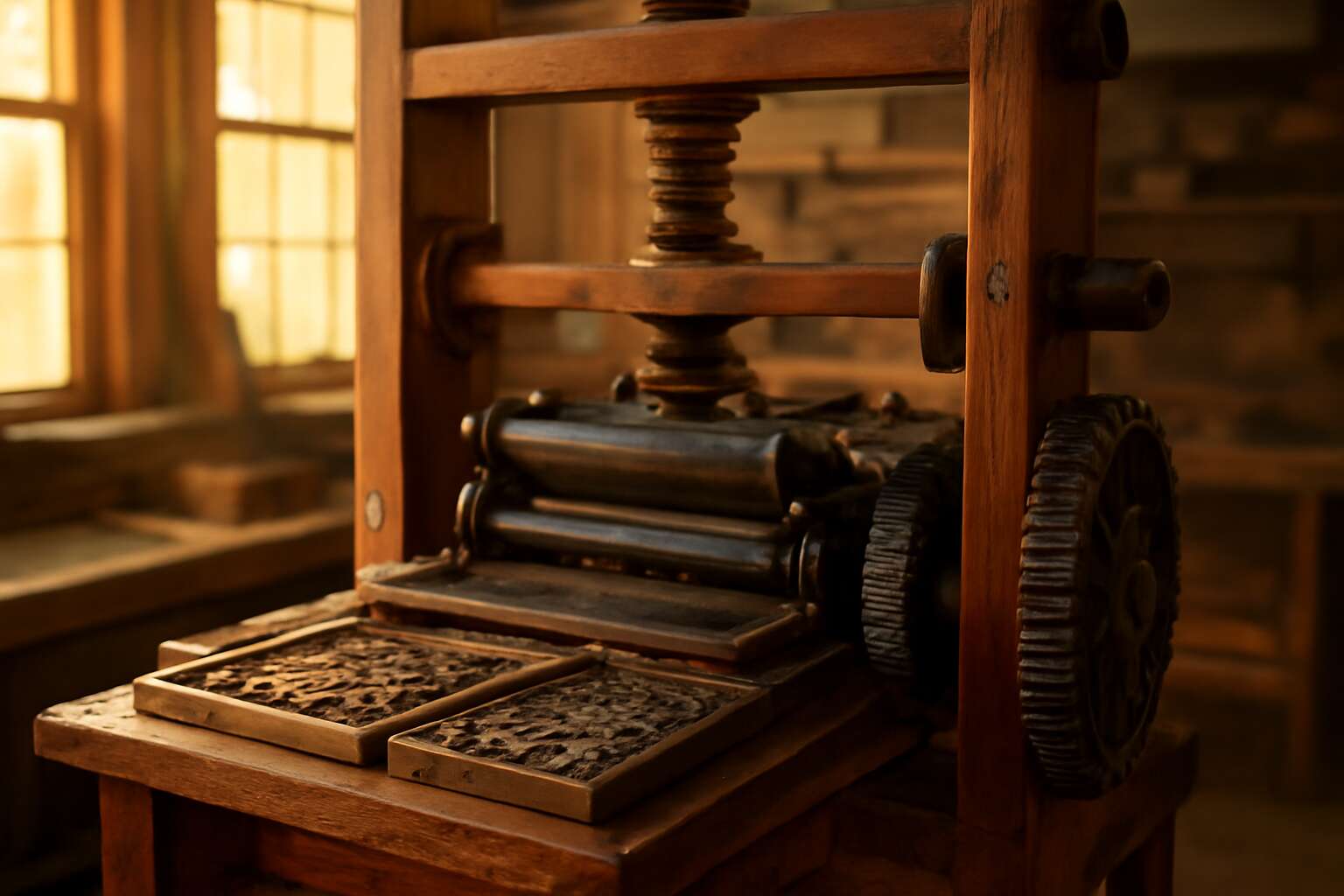
Origins of the printing machine discovered by Gutenberg
Predecessors of printing: woodblock and manuscript traditions
A single press changed how towns talked to themselves—ideas moved faster than couriers, markets formed around printed pages, and knowledge became a shared resource. The printing machine discovered by Gutenberg didn’t appear in isolation; it rose from a long line of craft and copying traditions.
- Woodblock printing laid down images and text on wood, a tactile method that travelled across Asia and into Europe before movable type.
- Manuscript traditions preserved detail through hand copying, glosses and marginal notes, building literacy and demand that later quickened with metal type.
These precursors built the linguistic backbone of print. The Gutenberg breakthrough fused movable type with a robust press, turning long manuscripts into rapid, repeatable pages. In South Africa, printers honour that lineage while driving modern quality and speed for clients.
Gutenberg’s movable type: the breakthrough concept
Across the 15th century, a simple iron press did more than print ink. It rewired commerce, literacy, and rumor. The breakthrough turned manuscripts into pages—fast enough to saturate markets.
That breakthrough is often summed as the printing machine discovered by Gutenberg, where movable type met a sturdy press. It transformed long texts into rapid, repeatable units that could travel faster than couriers.
- Movable type enabled reuse of individual letters for new pages.
- Pressure from a solid press produced consistent ink impressions.
- Mass production lowered costs and broadened distribution.
Today, South Africa’s printers honor that lineage while pushing speed and quality for clients.
Early press mechanics and materials used in the first machines
An unseen screw, a spark of ink, and the printing machine discovered by Gutenberg rose from shadow to revolution. The press did more than lay ink on parchment; it collapsed distance, letting markets and rumors travel at the speed of thought. Pages multiplied, words moving faster than couriers!
Early mechanics leaned on a wooden screw press borrowed from wine and olive presses. The bed and platen were bound to iron and oak; the type itself used a durable alloy of lead, tin, and antimony. Oil-based ink with linseed oil and lampblack yielded clean, steady impressions.
- Wooden screw press heritage from agricultural presses
- Lead-tin-antimony type alloy
- Oil-based ink formula for metal type
In South Africa, printers honor that lineage while pushing speed and quality for clients.
Spread of printing technology in Europe and beyond
From the forge of possibility, the printing machine discovered by Gutenberg unfurled its iron wings. A spark turned parchment into a chorus; a single press could birth hundreds of pages in a day, and ideas raced ahead of messengers. The room brightened with ink and intention, and the world began to listen with new, patient ears.
Spread flowed like a measured iamb across Europe and beyond, carried by traders, scholars, and clashing sails. In time, the shelves of knowledge crossed the Mediterranean, and ships bore the miracle to Africa and the Indian Ocean. South Africa’s printers inherit that lineage, turning speed and precision into local relevance for every client.
Several forces kept the press alight:
- Trade routes and urban centers
- Monastic libraries and scholarly guilds
- Standardized metal type and reliable ink
- Rising literacy and demand for books
The printing machine discovered by Gutenberg: historical context and invention
Economic and cultural forces that favored a printing solution
The printing machine discovered by Gutenberg did more than ink the page; it reorganized memory itself. In the mid-1400s a single press could turn a scribal dream into a public conversation, birthing a cultural tide that reshaped religion, science, and commerce!
Economic and cultural forces favored this leap: bustling towns, rising literacy, and a demand for affordable, reliable texts. The system promised speed, consistency, and reach, inviting universities, guilds, and merchants to scale ideas across borders. For South African readers, the resonance is intimate—printed words travel as swiftly as opportunity does, carrying voices from Mainz to the world and back again.
- Expanding urban markets fueling demand for primers and pamphlets
- Growing literacy creating new audiences for printed material
- Trade networks that accelerated distribution across regions
Movable type development and type-setting techniques
In Mainz during the 1450s, the printing machine discovered by Gutenberg wasn’t just a device; it reprogrammed memory itself. A handful of presses turned scribal dreams into public conversation, and the ripple is felt in South Africa today—printed words moving as swiftly as opportunity!
Movable type development turned text into reusable blocks. Metal letters cast from punches and matrices could be arranged in a galley, locked into a forme, and inked with oil-based ink before a press delivered the page.
Key mechanics at work included:
- Standardized characters and spacing
- Reusable matrices for speed
- Locking into a forme for consistency
This tiny machinery unleashed speed, standardization, and global reach, turning a workshop into a marketplace of ideas.
Press design innovations: screw press to early rotary concepts
In a moment when ink met ambition, the printing machine discovered by Gutenberg rewrote the map of knowledge. A single press could turn a scribal whisper into a public chorus, and the echo travels from Mainz to the modern newsroom.
Set against the waning glow of manuscript culture, the invention emerged from practical craft and bold experimentation. Early press mechanics married a robust screw press with movable metal type, and the journey hints at rotary ambitions that would someday spin faster, farther.
- Screw press lineage for measured pressure and uniform impressions
- Forme lockups and ink transfer that stabilized pages
- Fleeting glimpses of rotary concepts pointing to rapid repetition
These innovations reprogrammed production, enabling broader discourse and cross-continental exchange, a momentum felt as strongly in South Africa’s publishing houses today as anywhere. The story remains a brilliant fusion of craft, method, and daring.
Dating, documentation, and scholarly debates about the invention
In Mainz, ink met ambition as the printing machine discovered by Gutenberg began turning scribal whispers into public discourse. The leap from hand-copied pages redefined knowledge, page by pressed page.
Dating and documentation are tangled in scholarly debate. Some trace proto-experiments to the 1430s; others anchor the breakthrough in the mid-1450s with the Gutenberg Bible as a landmark. Evidence is fragmentary: city records, workshop notes, incunabula that survive as traces.
- Mainz workshop records
- The 42-line Bible as a dating anchor
- Correspondence of Fust and Schöffer
From Mainz to South Africa’s printing houses, the tale remains a luminous blueprint for cross-cultural exchange, proof that invention is craft and courage.
Initial uses and the impact on literacy and knowledge dissemination
Prints could outrun handwriting in days, not years. The printing machine discovered by Gutenberg arrived in Mainz in the 1450s, combining metal type, ink, and a firm press to turn whispered ideas into public conversation. I picture a Mainz workshop buzzing with clinks as letters stood ready to travel across courts and markets. What followed reshaped knowledge, page by pressed page.
Initial uses included:
- bibles, devotional texts, and scholarly pamphlets
- pamphlets that spread news quickly across towns
- city proclamations and legal notices
The spread of printed works widened access, lowered costs, and accelerated the flow of ideas—pamphlets, religious works, scientific notes reached new hands and towns. For readers in South Africa today, the legacy is clear: literacy and inquiry travel fast when pages are affordable.
Modern printing machine breakthroughs and types
From offset and web presses to digital printing technologies
Billions of pages roll off presses every year, and the drumbeat of modern printing keeps pace with demand. The phrase printing machine discovered by continues to echo in archives, reminding us that invention is a long arc—from grunt labor to digital precision.
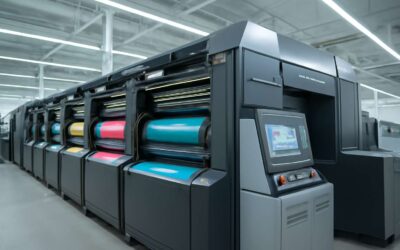
Today’s breakthroughs span classic offset and fast web presses to the precision of digital printing technologies. To illustrate, consider these core types that shape production today:
- Offset lithography for high-volume runs with consistent color quality
- Web presses designed for continuous, roll-fed materials
- Digital printing technologies enabling on-demand, variable data, and shorter lead times
In South Africa’s market, we see these tools translate into flexible schedules, lower waste, and bold local campaigns that reach readers where they live.
Inkjet and laser printing: core principles and applications
Speed without sacrificing nuance—today’s printers spit color with the rhythm of a drumbeat, turning hours of planning into minutes of print. In this era, inkjet and laser printing stand as twin engines of modern production, pushing on-demand jobs and intricate graphics from concept to finished sheet with striking ease!
Inkjet printing embodies precision through tiny droplets, variable data, and a broad color gamut; it thrives on on-demand runs and flexible media. Laser printing relies on dry toner, rapid fusing, and near-photographic text clarity. Observe how these forces shape campaigns, packaging, and signage across our local market.
- Inkjet: drop-on-demand, wide color range, scalable on various media
- Laser: dry toner, high speed, razor-sharp text
Even within the long arc of invention, the whisper of the printing machine discovered by lingers as designers chase efficiency, fidelity, and greener workflows in South Africa.
Specialty printing: textile, packaging, and three-dimensional printing
In the last decade, demand for customized textiles and packaging jumped 35%, a pulse that proves the printing machine discovered by curiosity still drives production. Breakthroughs arrive as a chorus of smarter inks, smarter feeds, and greener workflows.
Specialty printing now fuses textile, packaging, and three-dimensional formats into a single, agile ecosystem. Here are the standout avenues:
- Textile printing: direct-to-garment and dye-sub methods deliver vibrant, durable fabrics for on-demand fashion and homeware.
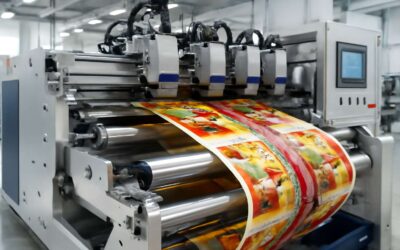
- Packaging printing: high-resolution graphics on corrugated and flexible substrates with quicker changeovers and tighter color control.
- Three-dimensional printing: additive manufacturing of polymers and composites turns prototypes into finished parts and tooling at surprising speed.
In South Africa, these breakthroughs reshape studios and production floors, where efficiency, fidelity, and greener footprints become daily commitments.
Sustainability and energy efficiency in contemporary presses
In a market that demands speed and soul, industry notes show up to 40% energy savings when modern presses run optimized workflows. The printing machine discovered by curiosity now hums with purpose! It turns color into less wastage and more wonder. These machines fuse throughput with stewardship, a duet of performance and responsibility.
From digital inks to intelligent heat, sustainability and energy efficiency sit at the core of design. Think LED curing, intelligent heat recovery, and modular feeds that shrink setup times.
Key accelerants include:
- Closed-loop ink recirculation and waste-aware color management.
- LED-curing and energy-regenerative drives cutting idle power.
- Modular, scalable feeds enabling rapid changeovers and minimal waste.
In South Africa, studios on every coast embrace these shifts, weaving local craft into global standards.
Automation, sensors, and connectivity in modern printing workflows
Across South Africa’s studios, throughput climbs when workflows find their voice, delivering tangible gains—industry chatter hints at a 28% uplift in speed with optimized automation. printing machine discovered by curiosity, turning color into efficiency and ceremony into commerce.
Automation, sensors, and connectivity form the spine of modern printing workflows.
- Automation coordinating feeders, inks, and drying for seamless runs.
- Sensors gauging color, substrate tension, and state for on-the-fly corrections.
- Connectivity linking in-plant devices to cloud jobs and remote diagnostics.
From Cape Town to the coast, South African studios weave local craft into global standards, letting every spectrum of color travel with confidence and traceability in a world of rapid change and responsive making.
Maintenance innovations and predictive maintenance practices
In South Africa’s studios, throughput climbs when workflows find their voice. A printing machine discovered by curiosity continues to fuel breakthroughs, and recent figures point to roughly a 28% uplift where automation is tuned for speed and precision.
Automation coordinates feeders, inks, and drying for seamless runs, while sensors gauge color, substrate tension, and state for on-the-fly corrections. Connectivity stitches in-plant devices with cloud jobs and remote diagnostics, turning data into confident color decisions.
Maintenance innovations now emerge as a quiet revolution:
- Condition-based maintenance driven by vibration and ink quality analytics
- Remote diagnostics and cloud dashboards for real-time alerts
- Predictive maintenance calendars that minimize downtime
From Cape Town to Durban, technicians blend local craft with global standards, chasing color reliability and traceability as the world shifts. That legacy—the printing machine discovered by curiosity—still guides our approach.
SEO strategy for content about the printing machine discovered by
Keyword research and long-tail variations around printing machine discovery
In South Africa’s print scene, SEO wields more clout than a high-speed press. A focused content strategy can lift visibility, especially when the keyword printing machine discovered by surfaces in niche searches that matter to printers and buyers alike. This approach stays punchy, local, and useful.
SEO basics start with intent and long-tail variations around printing machine discovery. Align content with SA readers and local industries like packaging or textiles. The process can be visual and practical:
- Identify intent signals: informational, navigational, transactional
- Develop long-tail variations around printing machine discovery
- Map content to reader journeys and local queries
Finally, keep readability high with concise paragraphs, SA-friendly examples, and schema markup to signal machine types and usage. The aim is to turn curiosity into trust without jargon, helping South African buyers navigate a complex printing landscape.
On-page optimization: titles, headers, and meta descriptions for history topics
In South Africa’s bustling print landscape, over 70% of buyers begin their journey online, filtering curiosity into decisions. That heartbeat fuels on-page optimization for history topics like printing machine discovered by, turning data into a compass for readers and search engines alike.
Titles that pin the mystery while clarifying intent, headers that map the reader’s path, and meta descriptions that invite a click—these elements anchor the story for SA audiences, like a lantern guiding a night convoy. Use natural, varied sentence lengths and local references to packaging, textiles, or print houses to keep the tale grounded.
- Titles that merge history with local relevance
- Headers that follow reader questions
- Meta descriptions that promise context and clarity
The aim is to turn curiosity into trust without jargon, letting the history breathe while guiding the modern printer toward the right resources.
Structured data and schema markup for technical content
Across South Africa’s bustling print lanes, more than 70% of buyers begin online journeys, turning curiosity into decisions. The phrase printing machine discovered by becomes a breadcrumb—linking dusty archives to a modern, searchable landscape. For technical history, a well-structured data spine turns complexity into clarity.
Schema markup helps search engines parse the narrative, making the discovery legible to readers from Johannesburg’s print houses to Cape Town’s textile labs. The story benefits from JSON-LD declarations of publication date, author, and mainEntity, plus an FAQPage to address common questions without clutter.
- TechArticle and Article schema to anchor technical narratives
- FAQPage for anticipated questions about provenance, materials, and impact
- RelatedPackaging or Textile contexts linked via sameAs to build topical clusters
Keep the tone precise and regionally grounded, weaving in local packaging and printing workflows—so SA printers feel guided, not lectured, by an insight that respects craft and community.
Backlink strategy: authoritative sources, museums, and academic references
Across South Africa’s bustling print lanes, online journeys shape decisions at the speed of a running press. The phrase printing machine discovered by becomes a gateway—from dusty archives in Johannesburg to dynamic, searchable timelines that illuminate craft. A tight backlink strategy anchors this history in credible sources, letting readers trace provenance with confidence.
- Authoritative sources: peer-reviewed journals, established SA archives, and industry white papers.
- Museums and archives: national printing museums and university special collections offering verified artifacts.
- Academic references: theses, conference papers, and historical studies that illuminate provenance and technology.
Readers in Cape Town, Durban, and Joburg will sense the cadence of local workflows—ink, fiber, and packaging—woven into the discourse, while the trust signals of cited authorities anchor the story.
Content freshness and updates for historical technology topics
History ages like ink—only if you refresh it. Across South Africa’s print lanes, readers skim the surface and then linger on a well-timed, witty narrative.
For content about the printing machine discovered by, freshness means updating with newly unearthed artifacts, curator notes, and peer-reviewed updates that shape a reliable timeline. In Cape Town, Durban, and Joburg, readers expect local context paired with global significance.
- Credible sources verified by archives and museums.
- Active partnerships with national libraries and university collections.
- Regular micro-updates when new findings surface.


0 Comments